Explore Sri Lanka history from the Veddhas and ancient kingdoms to Ceylon, British rule, independence and civil war, and see how it shapes the sites you visit.
Sri Lanka History: Why It Matters for Your Trip
Sri Lanka history isn't background reading — it's the reason the island looks the way it does. The teardrop-shaped landmass off India's southern tip has been fought over, settled, and renamed for more than two thousand years, and almost every stop on a typical itinerary carries a layer of that story. The Ravana legend ties the island to the Ramayana epic long before written records. The Veddhas, Sri Lanka's indigenous people, predate everyone else by thousands of years. Later came Sinhalese kingdoms, Tamil dynasties, Arab traders, Portuguese priests, Dutch merchants, and British planters, each leaving something behind — a dagoba, a fort wall, a railway line, a tea estate.
Walk into Sigiriya without knowing it was a 5th-century royal citadel built by a king who murdered his father, and you'll see an impressive rock with a nice view. Know the backstory, and it becomes something else entirely. The same goes for Galle Fort, the Temple of the Tooth in Kandy, and the ruins at Anuradhapura and Polonnaruwa. This guide walks through the island's past in roughly the order it happened, then points you toward the sites, tours, and tickets where you can see it firsthand.
Early Settlement and Ancient Origins
Sri Lanka's human history stretches back at least 38,000 years, based on skeletal remains found in caves like Fa Hien Lena in the island's southwest. That makes it one of the longest continuously inhabited places in South Asia, well before the kingdoms most travelers come to see were ever built. The early inhabitants were hunter-gatherers living in the island's wet-zone caves and forests, and their direct descendants — or at least a population claiming that lineage — are the Veddhas, who still live in small numbers around Dambana near Mahiyangana.
What happened next is part history, part legend, and Sri Lankans don't always agree on where one ends and the other begins. I'd rather be upfront about that than pretend the record is cleaner than it is.
The Veddhas and Early Inhabitants
The Veddhas (also spelled Wanniyala-Aetto) are widely considered Sri Lanka's indigenous people, with communities still maintaining distinct traditions around Dambana in the island's east-central region. Their population today is small — commonly cited at a few thousand — and most Veddhas have shifted toward settled agriculture rather than the forest-based hunting lifestyle of past centuries. If you're genuinely interested in this history rather than just curious to gawk, a visit arranged through a responsible local guide or community-based tour is far better than an unplanned detour; drop-in "tribal village" stops sold cheaply near Mahiyangana can feel staged and extractive, and I'd avoid those.
Sinhalese Migration and the Ravana Legend
Sinhalese chronicles — particularly the Mahavamsa, a historical poem compiled around the 5th century CE — trace the Sinhalese people to Prince Vijaya, said to have arrived from northern India around the 5th century BCE with a group of followers. Most historians treat this as a founding myth layered over a more gradual process of migration and intermixing from the Indian subcontinent, rather than one dramatic arrival. Older still is the Ravana legend, tied to the Ramayana, which places the demon-king Ravana's kingdom on the island long before Vijaya. You'll hear Ravana referenced constantly around Ella and the central hill country — Ravana Falls and Ravana Cave are named for him — and while there's no archaeological proof behind the specific claims, the legend is taken seriously enough that it shapes how many Sri Lankans talk about their island's deep past.
Ancient Kingdoms and the Rise of Buddhism
Buddhism arrived in Sri Lanka around 247 BCE, according to tradition brought by Mahinda, son of the Indian emperor Ashoka, who converted the Sinhalese king Devanampiya Tissa. That single event reshaped the island's politics and architecture for the next two thousand years — nearly every ancient kingdom that followed built its legitimacy partly around patronage of Buddhism, and the monasteries, stupas, and rock carvings you'll visit today are the physical result.
This is also where ancient kingdoms of Sri Lanka get their structure: Anuradhapura first, then Polonnaruwa, then a series of shifting capitals as Sinhalese kings retreated from South Indian invasions and, eventually, colonial pressure, ending at Kandy.
Anuradhapura, Polonnaruwa, Kandy and Galle each represent a different era of Sri Lankan history and reward different kinds of visits.
Sri Lanka's major historical sites compared: era, location and what to expect
| Site | Era | Distance from Colombo | Best for |
|---|---|---|---|
| Anuradhapura | Ancient Sinhalese capital (4th c. BCE–10th c. CE) | Approx. 4-5 hrs by road | Dagobas, Buddhist pilgrimage history |
| Polonnaruwa | Medieval Sinhalese capital (11th-13th c.) | Approx. 4-5 hrs by road | Compact ruins, easy cycling tour |
| Sigiriya | Royal citadel (5th c. CE) | Approx. 3-4 hrs by road | Rock fortress, frescoes, views |
| Kandy | Last Sinhalese kingdom (to 1815) | Approx. 3 hrs by road | Temple of the Tooth, royal history |
| Galle Fort | Colonial era (Portuguese, Dutch, British) | Approx. 2 hrs by road | Walkable ramparts, colonial architecture |
Travel times are approximate by car and vary with traffic and route; check current options when booking transport or tours.
Anuradhapura and Polonnaruwa
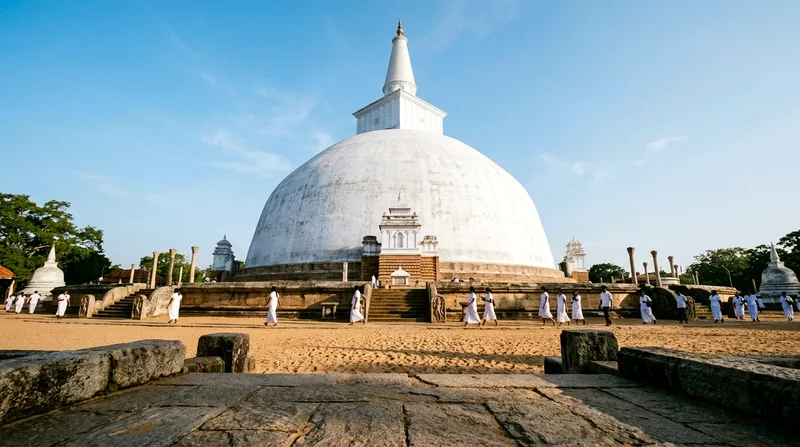
Anuradhapura served as the island's capital for over a thousand years, from around the 4th century BCE to the late 10th century CE. Its dagobas — massive brick stupas like Jetavanaramaya and Ruwanwelisaya — rank among the tallest pre-modern structures anywhere in the world, built without steel and still standing. When Chola invaders from South India took the city in 993 CE, the Sinhalese kingdom shifted to Polonnaruwa, which became the next capital and reached its peak under King Parakramabahu I in the 12th century, known for an enormous irrigation reservoir, the Parakrama Samudra, still in use today.
Both sites are UNESCO World Heritage listings and sit roughly two to three hours apart by road from Dambulla or Sigiriya, making a combined two-day "Cultural Triangle" itinerary the standard way to see them — worth booking as a guided day tour rather than self-driving if you want the history explained on-site rather than guessed at from a signboard.
Kandy and the Last Kingdom
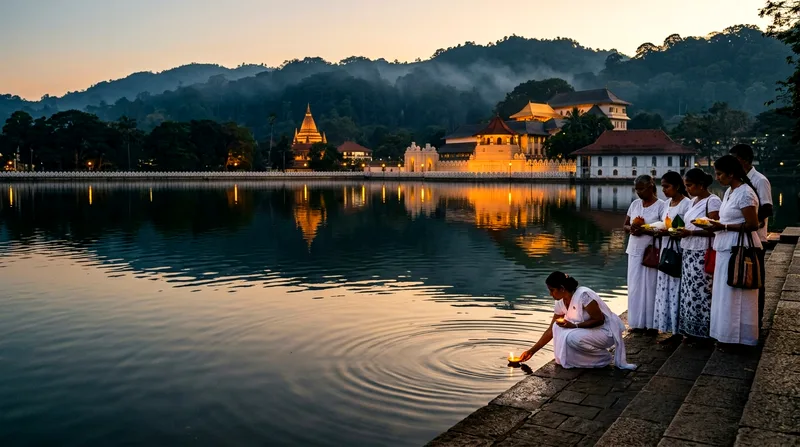
Kandy became the final seat of Sinhalese royal power, holding out against the Portuguese and Dutch and only falling to the British in 1815 — making it the last independent kingdom in Sri Lanka and one of the last in South Asia to fall under European colonial control. The Temple of the Tooth (Sri Dalada Maligawa), which houses what's venerated as a relic of the Buddha's tooth, sits at the center of the old royal complex and remains the most important Buddhist pilgrimage site on the island. Evening puja ceremonies are open to visitors and worth timing your visit around — check current times when booking, since they shift slightly with the temple's schedule, but they typically run in the early morning and again in the evening.
From Taprobane to Ceylon: Names and Colonial Rule
Few countries have been renamed as often as Sri Lanka, and the names map fairly neatly onto who was in charge. Understanding the sequence makes old maps, colonial-era documents, and even tea brand names ("Ceylon tea" is still used commercially) make sense.
Sri Lanka's Old Names Explained
The island's old names reflect a long list of outside visitors. Ancient Greek and Roman geographers called it Taprobane, a name that shows up on maps as early as the 4th century BCE and persisted in European cartography for nearly two thousand years. Arab traders called it Serendib — the root of the English word "serendipity," coined later from a Persian fairy tale about the island's princes. Sinhalese sources used Lanka or Sinhale. When the Portuguese arrived in the 16th century they adapted the name to Ceilão, which the Dutch rendered as Ceylan, and the British finalized as Ceylon — the name that stuck officially until 1972, when the newly republican government renamed the country Sri Lanka, meaning "resplendent island" in Sanskrit.
Portuguese, Dutch and British Eras
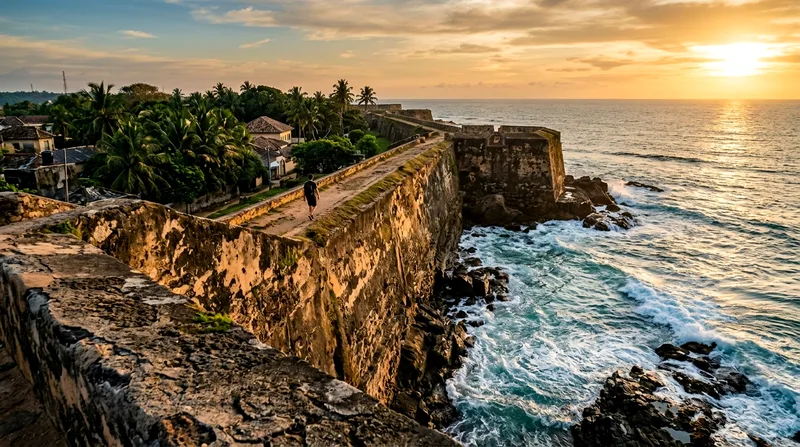
Portuguese traders arrived in 1505, initially after cinnamon, and gradually took control of the coastal regions over the following century, bringing Catholicism with them — still visible in the large Catholic population around Negombo today. The Dutch ousted the Portuguese in 1658, ran the coast through the Dutch East India Company, and left behind Galle Fort's current ramparts, canals, and colonial townhouses, largely rebuilt in stone between 1649 and the 1790s. The British took over Dutch holdings in 1796 and, by defeating the Kandyan kingdom in 1815, became the first power to control the entire island. British rule brought the railway network, the plantation economy — tea replaced coffee after a leaf disease epidemic in the 1870s — and the large-scale import of Tamil labor from South India to work those estates, a point that matters later. Galle Fort today is a UNESCO site where you can walk all three colonial layers in an afternoon; a guided walking tour is worth the modest cost just to tell the Portuguese stonework from the Dutch and British additions, which aren't obvious to an untrained eye.
Independence and Civil War
The 20th century took Sri Lanka from colony to independent state to a country scarred by one of South Asia's longest civil conflicts. This part of the history is less comfortable to package as a tourist attraction, but ignoring it means missing why the island feels different depending on which region you're in.
Path to Independence in 1948
Sri Lanka gained independence from Britain on 4 February 1948, following a largely peaceful constitutional process rather than an armed independence movement — a contrast with India's independence the previous year. The country initially kept the name Ceylon and remained a dominion within the British Commonwealth, with the British monarch as head of state, until the 1972 constitution declared it a republic and adopted the name Sri Lanka. Early post-independence politics centered on Sinhalese-majority governments, and policies like the Sinhala Only Act of 1956, which made Sinhala the sole official language, began widening a divide with the Tamil minority that would later turn violent.
Civil War and Recovery
Civil war broke out in 1983 between the Sri Lankan government and the Liberation Tigers of Tamil Eelam (LTTE), who sought a separate state for Tamils in the island's north and east. The conflict ran for 26 years, ending in 2009, and estimates of the death toll commonly range from 80,000 to 100,000, with the final months around Mullaitivu drawing particular international scrutiny over civilian casualties. Tourism infrastructure in the north — around Jaffna in particular — is newer and less developed than in the south as a direct result; roads, rail links, and hotels there were rebuilt largely after 2009. Jaffna is worth visiting for its distinct Tamil culture, the Jaffna Fort, and Nallur Kandaswamy Temple, but go in with realistic expectations about tourist infrastructure compared to Kandy or Galle, and travel with a guide who can speak to the region's recent history with care rather than treating it as a curiosity.
Religion and Cultural Influences Today
Sri Lanka religion today is a direct map of its history — each wave of migration, trade, and conquest left a faith behind, and all four major religions remain visibly practiced rather than just historically present. Roughly 70% of the population is Theravada Buddhist, concentrated among the Sinhalese majority, with Hinduism, Islam, and Christianity each maintaining substantial communities, particularly Hindu Tamils in the north and east, Muslims descended largely from Arab trader communities along the coast, and Catholics concentrated around Negombo and parts of the west coast.
Buddhism, Hinduism, Islam and Christianity
You'll see this religious layering physically on the ground: a Buddhist dagoba, a Hindu kovil, a mosque, and a Catholic church can sit within a few streets of each other in towns like Kandy or Colombo's Pettah district. The Esala Perahera in Kandy, a ten-night festival usually held in July or August, centers on the Buddhist tooth relic but incorporates Hindu temple processions as part of the same event — a genuinely unusual bit of religious overlap worth planning a trip around if the dates line up with your visit. Avoid treating any of these sites as pure photo opportunities; dress codes (shoulders and knees covered, shoes off at Buddhist and Hindu sites) are enforced, and showing up in beachwear at Dalada Maligawa will get you turned away or handed a sarong at the door.
Tamil and Indian Tamil Heritage
It's worth distinguishing between two separate Tamil populations, since the distinction comes up constantly in discussions of Sri Lankan politics and history. Sri Lankan Tamils trace their presence on the island back many centuries, concentrated historically in the north and east around Jaffna. Indian Tamils (sometimes called "Hill Country Tamils" or "Plantation Tamils") are largely descended from laborers brought over by the British in the 19th century specifically to work tea estates around Nuwara Eliya and the central highlands — a different migration with a different, more recent history, and one tied directly to the tea industry you'll likely tour if you visit the hill country.
Sri Lanka Timeline at a Glance
If you want the whole sweep in one pass: early human settlement from roughly 38,000 years ago; Sinhalese migration traditions from around the 5th century BCE; Buddhism's arrival in 247 BCE; Anuradhapura as capital until 993 CE; Polonnaruwa's peak in the 12th century; the Kandyan kingdom surviving until 1815; Portuguese arrival in 1505, Dutch takeover in 1658, British control completed in 1815; independence in 1948; republic status and the name Sri Lanka adopted in 1972; civil war from 1983 to 2009. None of this needs memorizing before a trip, but having the rough order in your head turns a packed two-week itinerary — Colombo, Kandy, the Cultural Triangle, Galle — into a narrative instead of a checklist of ruins and forts that otherwise start blurring together by day four.
Planning a History-Focused Trip to Sri Lanka
If history is your main reason for visiting, the standard "Cultural Triangle" route — Anuradhapura, Polonnaruwa, Sigiriya, and Dambulla's cave temples — covers the ancient kingdoms efficiently in three to four days, and most tour operators sell it as a fixed multi-day package with a driver-guide, which is worth it here given how spread out the sites are. Add Kandy for the last kingdom and the tooth relic, then finish on the coast at Galle Fort for the colonial layer. That's a loop most people complete in 10 to 12 days without rushing.
Compare that to other regional options: Cambodia's Angkor complex is more architecturally overwhelming in one spot, and India's Rajasthan forts cover a longer royal history, but neither packs ancient, medieval, and three separate colonial periods into an island you can cross by car in under eight hours the way Sri Lanka does. It's also considerably less built-up for tourism than Bali or Thailand's historical circuits around Ayutthaya — a trade-off that cuts both ways, since infrastructure around sites like Polonnaruwa is more basic, but crowds are thinner too. Check current tour prices and multi-day Cultural Triangle packages before booking, and consider pairing the ancient sites with a Kandy Esala Perahera trip if your dates allow — it's genuinely one of the more significant religious events in the region to witness firsthand.
Frequently asked questions
What was Sri Lanka called before Ceylon?
Before "Ceylon," the island was known by several names depending on who was describing it. Ancient Greeks and Romans called it Taprobane. Arab traders used Serendib. Sinhalese sources referred to it as Lanka or Sinhale. The Portuguese adapted this to Ceilão in the 16th century, which the Dutch and later the British turned into "Ceylon," the name used officially until 1972.
When did Sinhalese people arrive in Sri Lanka?
Sinhalese chronicles trace their origin to Prince Vijaya's arrival from northern India around the 5th century BCE, as recorded in the Mahavamsa. Most historians view this as a founding legend sitting atop a longer, more gradual process of migration from the Indian subcontinent that likely began earlier and continued over several centuries rather than happening in one event.
When did Britain take over Sri Lanka?
Britain took control of Dutch coastal holdings in Ceylon in 1796, then gained full control of the island in 1815 by defeating the Kingdom of Kandy — the last independent Sinhalese kingdom. That made Britain the first colonial power to rule the entire island, a position it held until independence in 1948.
Why is Sri Lanka different from India?
Despite sitting just off India's southern coast and sharing deep historical ties, Sri Lanka developed a distinct Sinhalese-Buddhist majority culture, its own royal dynasties centered at Anuradhapura, Polonnaruwa and Kandy, and a separate colonial trajectory under Portuguese, Dutch and British rule that didn't fully overlap with British India's administration. Its religious makeup, language (Sinhala, distinct from Indian languages), and post-independence history also diverged significantly.
What role did Indian migration play in Sri Lankan history?
Indian migration shaped Sri Lanka at multiple points — ancient Sinhalese migration traditions trace back to northern India, while medieval Chola invasions from South India repeatedly challenged Sinhalese kingdoms and briefly took Anuradhapura in 993 CE. Much later, the British brought large numbers of Tamil laborers from South India in the 19th century to work tea plantations, creating the distinct Indian Tamil community still centered in the hill country today.