Anuradhapura vs Polonnaruwa compared on compactness, ticket cost level, cycling appeal and ruins. Find out which Sri Lankan ancient capital suits your time.
Anuradhapura and Polonnaruwa at a Glance
Anuradhapura vs Polonnaruwa is one of the first decisions anyone planning a Cultural Triangle trip has to make, and it's a genuinely close call. Both are former royal capitals, both hold UNESCO World Heritage Site status, and both sit within a couple of hours of Sigiriya and Dambulla, making them natural add-ons to any itinerary built around Kandy or the central hill country.
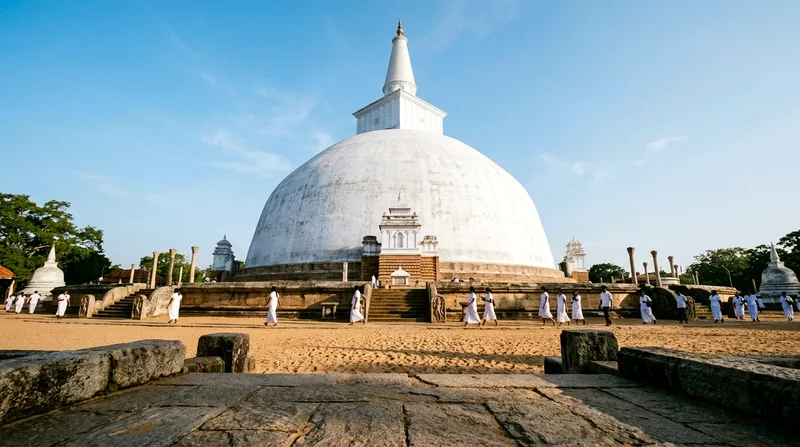
The core difference comes down to scale and era. Anuradhapura was Sri Lanka's capital for well over a thousand years, from around the 4th century BC until the late 10th century AD, which means its ruins are older, more scattered, and layered across a much larger area — some estimates put the archaeological zone at over 40 square kilometres, though the visitor-relevant core is smaller. Polonnaruwa became capital afterward, flourishing mainly in the 11th to 13th centuries, and it was built with more planning discipline, so its monuments sit closer together.
I'd argue Polonnaruwa is the more rewarding visit for most travellers, simply because density beats sprawl when you're on a schedule. Anuradhapura has the bigger historical weight — it's genuinely one of the oldest continuously settled cities in the world — but that weight doesn't always translate into a more satisfying few hours on a bicycle in 32°C heat. If you're choosing based on sheer "wow per hour," Polonnaruwa usually delivers more.
Historical timeline and UNESCO status
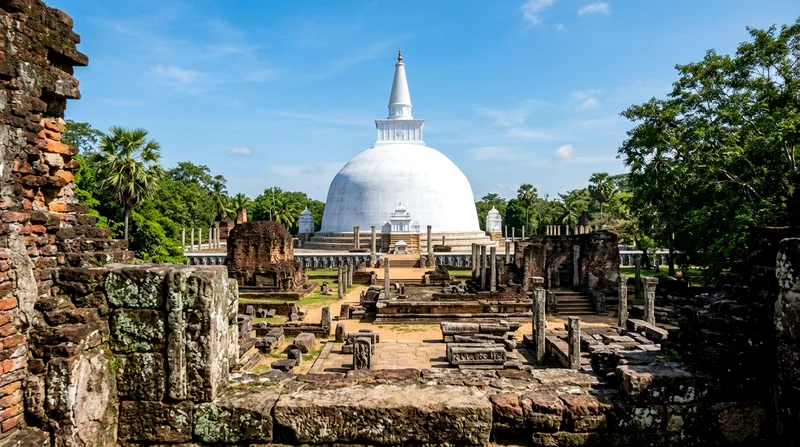
Anuradhapura's UNESCO listing dates to 1982, recognising it as the first of the island's great Buddhist monastic capitals, home to the sacred Bodhi tree said to have grown from a cutting of the original tree in Bodh Gaya. Polonnaruwa was inscribed in 1982 too, but as a shorter-lived, more compact royal centre — roughly two centuries of major building versus Anuradhapura's twelve-plus. That timeline gap explains a lot: Anuradhapura has more ruins because it had far longer to accumulate them, but also more decay, more rebuilding over rebuilding, and more sites that are now just brick foundations rather than intact structures.
Compactness and Time Needed
This is where the two cities really diverge, and it's probably the single biggest factor in your decision. Polonnaruwa's major monuments — the Quadrangle, the Gal Vihara rock-cut Buddhas, the Rankoth Vehera stupa, the Lankatilaka image house — are arranged along a route you can comfortably cover by bicycle in three to four hours. Anuradhapura's sites are spread across a much wider footprint, with significant gaps between the Sri Maha Bodhi, the Ruwanwelisaya stupa, Jetavanaramaya, and the Abhayagiri monastery complex, often requiring a vehicle or a longer cycling stint to connect them all.
If you're short on time, this matters more than the historical pedigree. A rushed half-day at Anuradhapura usually means picking three or four highlights and skipping the rest, whereas a half-day at Polonnaruwa can genuinely feel complete.
Polonnaruwa is smaller, cheaper and easier to cycle, while Anuradhapura demands more time but offers a longer historical timeline.
Anuradhapura vs Polonnaruwa compared: size, cost, cycling and time needed
| Site | Time needed | Cost level | Cycling appeal | Ruin condition | Best for |
|---|---|---|---|---|---|
| Anuradhapura | Full day (6+ hrs) | Higher | Moderate — long distances | Mixed, many foundations only | History-focused travellers, couples with time |
| Polonnaruwa | Half day (3-4 hrs) | Mid-range | High — compact, flat loop | Well preserved, Gal Vihara sharp detail | Families, cyclists, time-poor travellers |
Typical figures based on published visitor patterns; ticket prices and opening hours change periodically, so confirm current rates before you travel.
Site layout and walking distances
Polonnaruwa's Quadrangle alone packs a dozen structures into an area you can walk around in twenty minutes, with the rest of the site organised in a rough loop that suits cycling far better than walking. Anuradhapura, by contrast, has its sacred sites separated by distances of 2–5 km in places, with little shade along the connecting roads. Walking the full Anuradhapura circuit isn't realistic in the island heat; you'll want a bike, tuk-tuk, or car-with-driver, and even then expect a half-day minimum just for the core monuments.
Half-day versus full-day visits
Budget half a day for Polonnaruwa and a full day for Anuradhapura if you want to see the headline sites properly rather than glimpse them from a moving vehicle. Families with young children or senior travellers who tire easily will likely find Polonnaruwa's compactness a relief — there's less walking between stops and more shaded rest points near the Quadrangle. Anuradhapura suits travellers who enjoy slower, more meditative exploration and don't mind returning the next morning to catch the cooler light.
Tickets and Cost Level
Both sites charge a single-entry ticket that covers the whole archaeological zone, and both sit in the mid-to-higher range of Sri Lanka's attraction pricing compared to, say, temple entries in Kandy. Anuradhapura's ticket has historically been priced slightly higher than Polonnaruwa's for foreign visitors, reflecting its larger scale and the number of monuments it covers, though both are modest compared to international UNESCO sites like Angkor Wat in Cambodia or the temples of Bagan in Myanmar. Prices change periodically, so always check current rates on the Sri Lanka Central Cultural Fund site or with your hotel before you go rather than relying on numbers quoted in older blog posts.
Neither ticket includes a guide, and neither site has much shade near the ticket counters, so budget extra for water and sun protection rather than assuming the entry fee covers everything you'll need.
How Polonnaruwa tickets compare with Anuradhapura
Polonnaruwa tickets tend to sit a notch below Anuradhapura's in cost, and the site also feels better value per rupee simply because you'll physically cover and see more of what you paid for within a shorter visit. Some travellers combine both tickets with the wider Cultural Triangle round ticket that also covers Sigiriya and sometimes Dambulla — worth asking about at the point of purchase, since buying separately can work out pricier if you're visiting three or more sites. Keep your ticket and any site map handed out at entry; some checkpoints within the complex ask to see it again.
Cycling, Getting Around and Ruin Condition
A Polonnaruwa cycling tour is close to the ideal way to see any ancient city in Sri Lanka. Bikes are available for rent near the entrance for a modest daily rate, the terrain is flat, the road surface inside the complex is generally good, and shade trees line much of the route. It's one of the few UNESCO sites in Asia where cycling between 1,000-year-old monuments feels completely natural rather than like a novelty.
Anuradhapura can be cycled too, and some visitors prefer it that way, but the distances are longer and traffic on the connecting roads is heavier since the modern town overlaps with the sacred zone. Many travellers end up hiring a tuk-tuk driver for a half-day at Anuradhapura instead, which costs more than a bike rental but covers the ground faster and lets the driver act as an informal guide.
Cycling tour appeal at each site
If cycling through ruins is part of your motivation for visiting — and for a lot of travellers comparing this trip to places like Angkor Wat or Bagan, it genuinely is — Polonnaruwa is the clear winner. The Gal Vihara statues, the Quadrangle, and the royal palace ruins all sit on a single loop that rewards a bike far more than a car. Anuradhapura's cycling experience is serviceable but less satisfying, mostly because you spend more time pedalling between sites than looking at them.
Preservation and architectural highlights
Polonnaruwa's monuments are, on balance, better preserved — partly due to their more recent construction, partly because the site was abandoned more suddenly and suffered less layered rebuilding over the centuries. The Gal Vihara's four rock-cut Buddha images are sharp enough in detail that you can still make out facial expressions and robe folds clearly. Anuradhapura's stupas, particularly Ruwanwelisaya, have been restored and are visually striking — Jetavanaramaya was once among the tallest brick structures in the ancient world — but much of the surrounding monastic complex is reduced to foundations and pillar stumps, which asks more of your imagination than Polonnaruwa does.
Who Should Pick Which
Solo travellers and backpackers moving fast through the Cultural Triangle should lean toward Polonnaruwa — it pairs naturally with a Sigiriya climb the same day if you start early, something Anuradhapura's scale makes impractical. Couples with a flexible schedule and a genuine interest in Buddhist history get more out of Anuradhapura, especially if they can spend a full day and return for the Sri Maha Bodhi at a quieter hour, early morning or late afternoon, when the site feels far less like a tour-bus stop.
Families with children under ten will likely find Polonnaruwa easier to manage: less walking, more shade, and the novelty of cycling keeps kids engaged longer than a slow walk around scattered ruins. Senior travellers who want to avoid long bike rides or extended walking in heat should consider a tuk-tuk tour of either site, but Polonnaruwa's compactness still makes for a shorter, less tiring day overall.
Anglers and surfers based on the south or west coast — Mirissa, Weligama, Arugam Bay — will find either site is a genuine detour, not a day trip; both require an overnight stay inland or a long return drive, so factor that into a surf-trip itinerary rather than trying to squeeze it into a rest day.
Time-constrained travellers and Cultural Triangle routes
If you're building a classic Cultural Triangle loop — Kandy, Sigiriya, Dambulla, and one ancient city — and only have one extra day to spare, Polonnaruwa slots in more easily. It's roughly an hour's drive from Sigiriya, versus close to two hours to reach Anuradhapura from the same base, and its shorter visit time leaves room for the Dambulla cave temples the same day. Anuradhapura or Polonnaruwa isn't really an either/or for travellers with 4+ days in the region — many do both, usually on separate days, rather than trying to rush one after the other.
Verdict: Which Ancient City Wins
There's no single winner here, which is a little unsatisfying as a verdict but it's the honest one. For time-constrained travellers, cyclists, and families, Polonnaruwa wins outright — it's smaller, better preserved, cheaper to visit, and far more enjoyable on two wheels. For travellers with a full day to spare, a genuine interest in Buddhist history, or anyone comparing this trip mentally to wandering Angkor Wat's outer temples, Anuradhapura wins on depth and atmosphere, even if it demands more patience and a vehicle to get between its monuments.
Compared with ancient sites elsewhere in Asia — Bagan in Myanmar, or the temple complexes of Cambodia — both Sri Lankan capitals are smaller in scale but less crowded, and neither requires the multi-day commitment that Angkor demands. If you've already been weighing Sri Lanka against Vietnam or Kerala for a cultural-history trip, know that the Cultural Triangle rewards slower travel more than either destination's temple circuits do.
Don't try to cram both sites plus Sigiriya into 48 hours; that's the most common planning mistake, and it leaves visitors exhausted and unable to properly appreciate any of the three. Pick one ancient city for this trip, do it properly, and save the other for a return visit — or extend your Cultural Triangle stay by a day. Check the wider Cultural Triangle planning pages on this site for how to sequence Sigiriya, Dambulla, Kandy, and your chosen ancient capital into one coherent route.
Frequently asked questions
Which is better, Anuradhapura or Polonnaruwa?
Neither is objectively "better" — it depends on your time budget. Polonnaruwa is more compact, better preserved, and faster to see properly, making it the stronger pick if you have half a day. Anuradhapura has a longer historical timeline and more spiritual significance but needs a full day to do justice, so it suits travellers with more flexibility.
Is Polonnaruwa worth seeing?
Yes — it's arguably the most rewarding ancient city visit in Sri Lanka per hour spent. The Gal Vihara rock-cut Buddha statues alone justify the trip, and the compact layout means you won't miss highlights the way you might rushing through Anuradhapura's wider spread.
How far is Anuradhapura from Polonnaruwa?
Roughly 100-110 km apart by road, which usually takes about two to two-and-a-half hours to drive depending on traffic through Habarana. Most Cultural Triangle itineraries visit one or the other as a day trip from a central base like Sigiriya or Habarana, rather than combining both in a single day.
Are the ruins in better condition at Polonnaruwa or Anuradhapura?
Polonnaruwa's monuments are generally better preserved, partly because the city was built later and abandoned more abruptly, leaving structures like the Gal Vihara statues remarkably intact. Anuradhapura's sites, built and rebuilt over 1,000+ years, are often reduced to brick foundations and pillar bases, requiring more imagination to picture their original scale.
Can you visit both sites in one day?
Not realistically if you want to see either properly. The drive between them takes over two hours each way, and each site deserves at least half a day on its own. If you're determined to see both, plan two separate day trips from a central base like Habarana or Sigiriya rather than one exhausting loop.