Compare guided and self-guided Galle Fort walking tours, from sunset rampart walks to history tours, and learn what to check before you book.
Which Galle Fort Tour Suits You
Galle Fort is small enough to cross on foot in twenty minutes, yet dense enough with layered history — Portuguese foundations, Dutch fortifications, British-era additions — that most visitors need help decoding it. The right galle fort walking tour depends less on budget and more on what you actually want from the hour or two you'll spend inside the walls. Someone chasing sunset photos over the Indian Ocean needs a different itinerary than someone trying to understand how a 17th-century Dutch trading post still has working churches, mosques and a Buddhist temple inside one square kilometre.
I'd steer most first-time visitors toward a guided walk, at least for their first pass through the fort. The streets inside the ramparts look similar enough — colonial facades, boutique shopfronts, the odd cat sleeping in a doorway — that without context you'll miss what makes one building different from the next. A guide will point out, for instance, which bastions were Portuguese originals and which the Dutch rebuilt after 1640, a detail that's invisible unless someone tells you.
History lovers and first-time visitors
If you only do one organised activity in Galle, make it a guided history tour of the fort. A knowledgeable local guide — ideally someone trained in Sri Lankan heritage interpretation rather than a general city guide — will walk you through the site's layered occupation: Portuguese defences from the 1500s, the Dutch East India Company's expansion into a full UNESCO World Heritage Site, and the British modifications added after 1796. Expect a route of roughly 1.5 to 2 hours covering the main bastions, at least one of the colonial churches, and the old Dutch Hospital precinct. Ask in advance whether the guide covers the Maritime Archaeology Museum, since not all standard tours include an indoor stop, and museum hours are limited compared with the open-air fort itself.
Families, photographers and solo travelers
Families with younger children generally do better with a shorter, flexible self-guided walk timed around nap schedules and ice cream stops rather than a fixed-length guided tour — the ramparts are flat and stroller-friendly in most sections, but the Black Fort steps and some bastion edges need supervision. Photographers should prioritise timing over guiding: the fort's golden hour, roughly an hour before sunset, turns the lighthouse and ramparts near Flag Rock into the best shot in Galle, and you don't need a guide standing in your frame for that. Solo travelers often get the best value from free, tip-based walking tours or small-group guided walks, which double as a cheap way to meet other travelers heading the same direction along the south coast toward Mirissa or Unawatuna.
Main Galle Fort Tour Types Compared
There isn't one definitive galle fort tour format — the options range from a free app-guided stroll to a private half-day walk with a specialist historian. None of them is objectively "best"; each trades off cost, depth and flexibility differently.
Guided tours give context and structure, while self-guided and free walks give flexibility and cost control — the right pick depends on how much history you want explained versus how much pace control you want.
Galle Fort walking tour types compared: duration, cost style and best fit
| Tour type | Typical duration | Cost style | Best for |
|---|---|---|---|
| Guided history tour | 1.5-2.5 hours | Fixed fee, booked ahead | First-time visitors, history lovers |
| Self-guided walk | Flexible, 1-3 hours | Free (own pace) | Budget travelers, families with kids |
| Free/tip-based walk | 1.5-2 hours | Tip-based (e.g. via GuruWalk) | Solo travelers, backpackers |
| Sunset walk | 60-90 minutes | Fixed fee, timed start | Couples, photographers |
| Private tour | 1.5-3 hours, flexible | Higher fixed fee | Seniors, families wanting pace control |
| Combination tour | Half-day | Fixed fee, bundled | World travelers short on time |
Durations and cost structures are typical ranges; always check current prices, group size and start times before booking.
Guided vs self-guided walks
A guided tour, whether booked through a local operator or joined as a drop-in group walk, typically runs 1.5 to 2.5 hours and includes a fixed route past the major bastions, at least one church, and usually a stop at a local café or shop (sometimes on commission, which is worth knowing going in). The upside is context — you'll actually learn why the Moon Bastion sits where it does. The downside is pace: you move on the group's schedule, not yours.
A self-guided galle fort walking tour costs nothing beyond what you spend on food or museum tickets, and you set your own pace entirely. Download an offline map before you arrive — fort Wi-Fi is patchy — and follow the rampart line clockwise from the Clock Tower. The trade-off is obvious: no one is there to explain what you're looking at, and first-time visitors often miss smaller landmarks like the old Dutch warehouse markings or the Sudharmalaya Temple tucked into a side street.
Sunset, private and combination tours
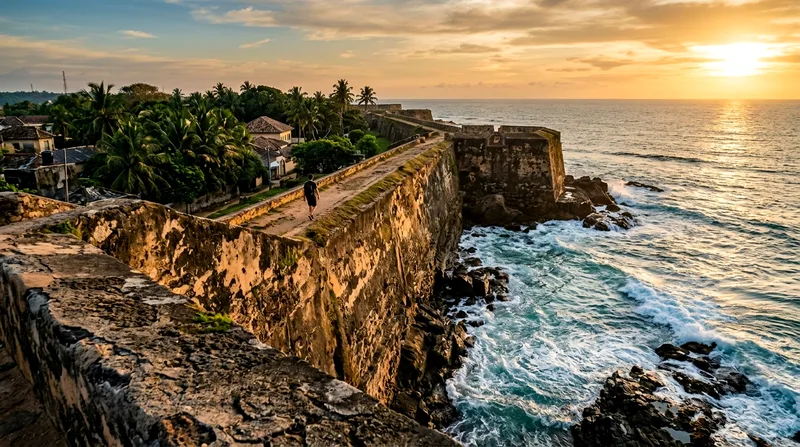
Sunset walks are usually shorter — 60 to 90 minutes — timed to end at the ramparts near Flag Rock or the lighthouse as the light drops. These suit couples and photographers more than history buffs, since guides tend to keep commentary light to prioritise the view. Private tours cost more than joining a group but let you set the pace, which matters for senior travelers or anyone with mobility concerns who wants to skip the steeper bastion climbs. Combination tours bundle the fort walk with a tuk-tuk ride through Galle town, a stilt fishermen stop along the coast, or a boat trip — useful if you're short on time in southern Sri Lanka and want to tick off several things to do in one booking, though you'll spend less time at each stop than on a dedicated fort tour.
Key Landmarks Every Tour Should Cover
Whatever format you choose, a few landmarks separate a decent galle fort tour from one that just wanders the shopping streets. If your itinerary skips most of these, look for a different option.
Clock Tower, Flag Rock and Moon Bastion
The Clock Tower, built in the 1880s, is the standard starting point for almost every guided and self-guided walk — it's easy to find, sits near the main entrance by the old gate, and gives you a fixed reference point if you get turned around later. From there, most routes head toward Flag Rock, a small promontory at the fort's southwestern tip where local divers sometimes jump for tips from tourists (tip only if you're comfortable with the practice; it's become somewhat touristy). Moon Bastion, on the northern stretch of the walls, offers one of the better unobstructed views back toward Galle harbour and is usually quieter than Flag Rock at sunset.
Churches, museum and Black Fort
The Dutch Reformed Church, dating to the mid-18th century, and All Saints' Anglican Church are both usually included on guided routes and worth ten minutes each even on a self-guided walk — the floor memorials and gravestones inside the Dutch Reformed Church are unusually well preserved. The Maritime Archaeology Museum, housed in a former warehouse, covers shipwreck finds off the Galle coast and is one of the few indoor, air-conditioned stops on a hot day — useful to know if you're walking in the midday heat. The Black Fort, the oldest surviving Portuguese-built section of the ramparts on the northeastern corner, gets skipped by rushed tours simply because it's a five-minute detour off the main loop; ask for it specifically if your guide doesn't mention it.
What to Check Before Booking
Before you commit to any galle fort guided tour, run through a short checklist. The fort is touristy enough that quality varies widely between operators, and a bad guide can make a two-hour walk feel like a sales pitch for a gem shop.
Inclusions, group size and guide expertise
Check exactly what's included — some tours bundle a museum ticket or a drink stop, others charge those separately. Group size matters more at Galle Fort than you'd expect, since the narrow lanes near the Clock Tower and the old gate get congested by mid-morning; a group of six to eight is manageable, a group of twenty is not. Ask whether the guide is locally licensed or affiliated with the Galle Heritage Foundation, and read recent reviews specifically mentioning the guide's depth of historical knowledge rather than just friendliness — plenty of guides are personable but thin on actual history.
Cancellation policy and accessibility
Galle gets heavy rain showers between May and September, and a fort walk in a downpour isn't worth doing — check the cancellation or rescheduling policy before you pay anything upfront. For accessibility, note that the rampart walk involves uneven stone surfaces, occasional steps at bastion entries, and no shade for long stretches; if you're traveling with a wheelchair user or someone with limited mobility, ask specifically which sections a private guide can route around, since the full loop isn't fully step-free.
Best Time to Book and Walk
Early morning, from around 6:30 to 8:30am, is the most comfortable time to walk Galle Fort — the heat hasn't built up, the cruise-ship crowds haven't arrived, and the light is good for photos without the orange cast of sunset. A guided galle fort sunset walk is the better choice for atmosphere over information; book it to start about 90 minutes before sunset so you reach Flag Rock or the lighthouse end of the ramparts as the light drops. Avoid midday between roughly 11am and 3pm unless your tour includes the air-conditioned Maritime Archaeology Museum as a heat break — the stone ramparts hold heat and there's minimal shade anywhere on the fort walls.
Compared with similar heritage walks elsewhere in Asia — Hoi An's old town in Vietnam, or Fort Kochi in Kerala — Galle Fort is smaller and walkable in under half a day, so there's little reason to book a multi-day pass or combine it with too much else. It doesn't have the scale of a Bali temple circuit or the built-up tourist infrastructure of Thailand's old cities, which is part of its appeal: you can genuinely cover the whole fort on foot without a vehicle. Book guided slots a day or two ahead in high season (December to March), since small-group tours do fill up; self-guided and free walks need no advance booking at all, just daylight and decent shoes.
Frequently asked questions
How long does a Galle Fort walking tour take?
Most guided tours run 1.5 to 2.5 hours covering the main bastions, at least one church and the Clock Tower area. A full self-guided loop with stops for photos and coffee can stretch to 3 hours, while a focused sunset walk is usually closer to 60-90 minutes.
Can you do a self-guided walking tour of Galle Fort?
Yes — the fort is compact, well signposted, and safe to walk independently. Download an offline map before arrival since Wi-Fi inside the walls is unreliable, and start at the Clock Tower so you have a fixed reference point for the loop around the ramparts.
Are there free walking tours in Galle Fort?
Free, tip-based walks are available through platforms like GuruWalk, where local guides lead small groups and you pay what you think the tour was worth. They typically run similar routes and lengths to paid guided tours, making them a solid option for solo travelers and backpackers.
Where do Galle Fort walking tours start?
The Clock Tower, near the fort's main entrance, is the standard starting point for almost all guided and self-guided routes. Some private tours instead start at the old Galle gate or the Dutch Hospital precinct, so confirm the meeting point when you book.
Are sunset tours available at Galle Fort?
Yes, sunset walks are a popular format, usually timed to finish near Flag Rock or the lighthouse as the sun drops over the Indian Ocean. They tend to be shorter and lighter on history than standard guided tours, geared more toward views and photography.