Compare Sri Lanka yoga teacher training by course type, curriculum, class size, setting and total cost, plus Yoga Alliance accreditation checks before you book.
Who Sri Lanka Yoga Teacher Training Suits
Sri Lanka has become one of South Asia's more practical places to train as a yoga teacher, and it's not just about the scenery. The south coast around Ahangama and Weligama has a dense cluster of studios and retreat centers, English is widely spoken, flights from Europe run direct or with one stop, and the cost of living keeps total course prices lower than equivalents in Western Europe. Compare that to training in Bali, where the yoga scene is larger but visa runs and accommodation costs have crept up, or Kerala, which leans more toward classical Ashtanga and Ayurveda-integrated courses with a stricter, less flexible daily schedule.
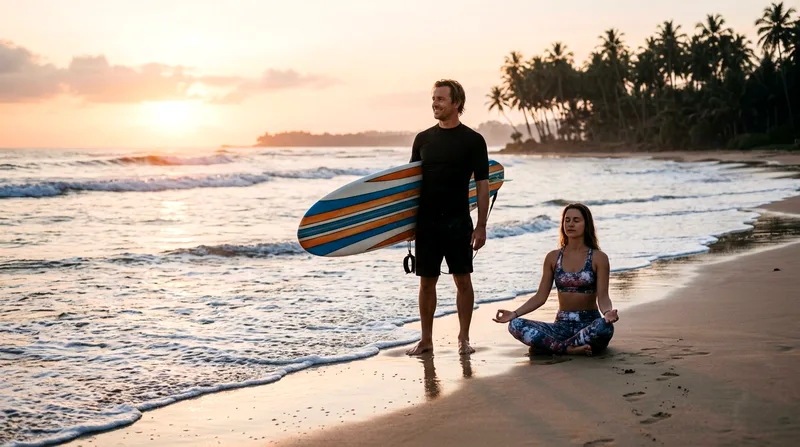
Sri Lanka works particularly well if you want a course that combines serious study with downtime you can actually use — surfing before or after class in Weligama, swimming in Ella's rock pools, or walking tea estate trails around the hill country on a rest day. That dual appeal is also the catch: some courses market themselves on lifestyle first and curriculum second. If you're choosing between Sri Lanka and Thailand, Thailand's teacher training scene (particularly in Koh Phangan and Chiang Mai) is larger and arguably more saturated, meaning more choice but also more variation in quality — the same caution applies in Sri Lanka, just on a smaller scale.
First-Time Trainees vs Experienced Practitioners
If you've never done a teacher training before, go for a 200-hour course — it's the entry-level, Yoga Alliance-recognized standard and the prerequisite for almost every 300-hour or advanced program worldwide. Expect roughly 150-200 contact hours over three to four weeks, covering asana, basic anatomy, philosophy, and a set number of supervised teaching practice hours (often 10-20). Don't attempt a 300-hour or advanced module as your first course — most reputable schools won't accept you without a completed 200-hour RYT-200 certificate anyway, and the pace assumes you already know how to cue a sun salutation without thinking about it.
Experienced practitioners with five or more years of consistent practice sometimes skip straight to a 300-hour course if they already hold a 200-hour certificate from elsewhere, using Sri Lanka as the location for the advanced module instead. This is common among people who did their foundational training in the UK, Germany, or Scandinavia and want a warm-climate intensive for the next tier. If that's you, ask specifically what percentage of the 300-hour curriculum is new material versus repetition of 200-hour content — some schools pad the hours.
Aspiring Teachers vs Deepening Your Own Practice
Not everyone taking a 200-hour course wants to teach professionally, and schools in Sri Lanka are generally comfortable with that — plenty of participants are there to deepen their own practice, build discipline, or take a career break. If teaching isn't the goal, a shorter 100-hour course (roughly 10-14 days, not Yoga Alliance-registered as a standalone teaching credential but useful as a foundation or a step toward the 200-hour level) might suit you better and costs less.
If you genuinely intend to teach — in a studio, online, or at retreats — prioritize courses with more practice-teaching hours and feedback sessions over courses that spend more time on extras like Ayurveda talks or excursions. Ask how many times each trainee actually leads a full class in front of peers during the course; some programs guarantee this in writing, others leave it vague.
Yoga Teacher Training Types Compared
Course "types" in Sri Lanka break down more by duration and setting than by brand, since most are run by small independent studios rather than large chains. The main decision is duration (100, 200, or 300 hours) crossed with location (coastal south, hill country, or lakeside). Style matters too — most 200-hour programs teach a Hatha and Vinyasa base with Yin or restorative modules added, since that combination covers the broadest range of future teaching contexts.
A 200-hour coastal course offers the best balance of accreditation, cost and lifestyle for most first-time trainees.
Sri Lanka yoga teacher training course types compared by duration, hours and setting
| Course Type | Typical Duration | Contact Hours | Accreditation | Best Setting | Best For |
|---|---|---|---|---|---|
| 100-Hour Foundation | 10-14 days | 90-110 | Not standalone Yoga Alliance credential | Coastal (Ahangama, Weligama) | Testing commitment, building a base |
| 200-Hour Immersion | 21-28 days | 180-220 | Yoga Alliance RYT-200 | Coastal and hill country | First-time trainees, aspiring teachers |
| 300-Hour Advanced | 25-30 days | 250-300 | Yoga Alliance RYT-300/500 (with prior 200hr) | Hill country, lakeside | Certified teachers upskilling |
| Specialised (Yin/Prenatal module) | 7-14 days | 70-100 | Varies, often non-standalone | Lakeside, hill country | Teachers adding a niche specialty |
Ranges are typical figures only; always confirm exact hours, accreditation status and inclusions directly with the school before booking.
200-Hour Immersion vs 100-Hour and 300-Hour Courses
The 200-hour immersion is the course most people mean when they say "yoga teacher training," and it's the Yoga Alliance benchmark for RYT-200 registration. Typical structure: daily schedule starting around 6am with pranayama and asana practice, a midday break, then afternoon sessions on anatomy, teaching methodology, and philosophy, finishing with evening meditation or Yin. Total contact hours run 180-220 depending on the school; course length is usually 21-28 days including one rest day per week.
The 100-hour yoga teacher training in Sri Lanka is shorter — typically 10-14 days — and works as either a standalone foundation course or a stepping stone toward the full 200-hour certification later (some schools let you apply the 100 hours toward a future 200-hour top-up, others don't, so ask directly). It's not accepted by Yoga Alliance as a teaching credential on its own.
A 300-hour course is the advanced tier, requiring a prior 200-hour certificate, and runs 25-30 days with deeper anatomy, adjustments, and often a specialization like Yin or prenatal yoga. Combined with a prior 200-hour, it qualifies you for RYT-500 status. If you're comparing against Vietnam or Goa's teacher training scene, Sri Lanka's 300-hour offerings are fewer in number, so you may have less choice on specialization than in Goa, which has a longer-established advanced-training circuit.
Coastal, Lakeside and Hill Country Settings
Ahangama and Weligama on the south coast dominate the market — flat, walkable towns with surf breaks nearby, making them the obvious pick if you want to combine training with learning to surf or swimming most afternoons. The trade-off is heat and humidity year-round, which makes the 6am start times less optional than they sound.
Hill country settings around Ella offer cooler mornings, tea plantation views, and a quieter atmosphere with fewer distractions — useful if you want to focus purely on study without a beach pulling your attention away. Kandy, inland and cooler than the coast, has a smaller but growing training scene, often with more emphasis on traditional philosophy given its proximity to Sri Lanka's Buddhist cultural sites. Lakeside venues, scattered around the hill country and southern lowlands, tend to be smaller operations with lower class sizes — sometimes under 10 students — which suits people who want more one-on-one correction time but who should check that smaller numbers haven't come at the cost of a thin teaching staff.
What to Check Before You Book
This is where most disappointment in the yoga teacher training sri lanka market comes from — not bad locations, but vague contracts. Schools vary hugely in how specific they are about what's actually included, and the ones that are cagey about details are usually the ones worth skipping.
Yoga Alliance Registration and Teacher Credentials
Yoga Alliance Sri Lanka registration means the school (Registered Yoga School, or RYS) has submitted its curriculum for review and meets minimum hour requirements across five categories: techniques, teaching methodology, anatomy and physiology, philosophy, and practicum. Ask for the school's RYS number and verify it directly on Yoga Alliance's school directory — don't take a logo on a website at face value, since directories get out of date and some schools let registration lapse without updating their marketing.
Separately, check the lead teacher's own credentials — how many years they've taught, where they trained, and whether they hold at least an RYT-500. A school can be accredited while the person actually running your sessions has limited teaching experience; accreditation covers the curriculum, not the individual instructor's skill in the room.
Inclusions, Class Size and Cancellation Terms
Ask exactly what's included: shared or private room, number of meals per day (most residential courses include three vegetarian meals daily), course materials, and whether excursions (waterfalls, temples, surf lessons) are bundled in or charged separately. Class size matters more than marketing photos suggest — anything above 20-25 trainees per teacher makes individual postural correction difficult; under 15 is noticeably better for feedback.
Cancellation and refund terms deserve real scrutiny. Many schools require a non-refundable deposit (commonly 20-30% of the total) with the balance due 30-60 days before start date, and some offer no refund at all within a few weeks of the course. Compare current prices, deposit terms and cancellation policies directly with schools before paying anything, since these terms change and aren't standardized across the industry.
Visa, Preparation and Logistics
Logistics trip people up more than the yoga itself. Sort your entry requirements and physical preparation separately, well before the course starts, rather than assuming the school will handle everything.
Entry Requirements for International Students
Most nationalities need an Electronic Travel Authorization (ETA) for Sri Lanka, applied for online before departure, generally valid for a stay of up to 30 days and extendable. A standard 21-28 day, 200-hour course usually fits within the initial visa period, but a 300-hour course or back-to-back trainings may require an extension, arranged through Sri Lanka's Department of Immigration in Colombo — budget a day for this if needed. Double-check current ETA rules on the official government site before booking flights, since categories and fees are adjusted periodically.
Fitness and Pre-Course Preparation
You don't need advanced flexibility to start a 200-hour course, but you should have a consistent practice — ideally 2-3 sessions a week for at least six months — before committing, since the daily schedule is physically demanding: two practice sessions most days plus hours of seated study. Arriving with no base fitness makes the first week genuinely hard on the body, particularly the wrists and lower back during longer Vinyasa sequences.
Bring a personal mat if you have a preferred thickness, though most schools provide one. Pack light, breathable clothing suited to coastal humidity if training in Ahangama or Weligama, and a layer for cooler hill country mornings in Ella or Kandy, where temperatures can drop noticeably before sunrise.
When to Book Your Training
Timing affects both comfort and value. Sri Lanka's two monsoon systems mean the "best" season depends heavily on which coast or region your chosen course sits in.
Seasons and Weather by Region
The south and west coasts, including Ahangama and Weligama, have their driest, most settled weather roughly December through March — also peak season for surf and the busiest (and priciest) time for training courses. The east coast and hill country, including areas near Ella, see their drier period roughly May through September, when the southwest monsoon is active elsewhere. Booking a coastal course in, say, July means more rain and rougher surf; booking a hill country course the same month is often a better bet. This split is less dramatic than Bali's single wet-dry pattern or Thailand's monsoon timing, but it's worth planning around rather than ignoring.
How Far Ahead to Reserve a Place
Popular 200-hour courses on the south coast during peak season (December-March) often fill 2-4 months ahead, particularly smaller programs capped at 12-15 trainees. For shoulder season (April, September-November) or hill country courses, 4-6 weeks ahead is usually enough. If your dates are fixed — around annual leave, for instance — book earlier rather than later, since the best-reviewed small-class courses sell out before the larger, less selective ones do. Compare current availability and prices across a few schools before committing a deposit.
Frequently asked questions
How long is a 200-hour yoga teacher training in Sri Lanka?
Most run 21-28 days, including one rest day per week, delivering 180-220 contact hours across asana, anatomy, philosophy and supervised teaching practice. A handful of intensive versions compress this into three weeks with longer daily hours — fine if you're used to a demanding schedule, exhausting if you're not.
Are yoga teacher training courses in Sri Lanka Yoga Alliance certified?
Many are, but not all — verify independently on Yoga Alliance's official school directory using the school's RYS number rather than trusting a logo on their website. Accreditation status can lapse, and some schools continue marketing old certifications after they've expired.
What is the average cost of yoga teacher training in Sri Lanka cost?
Total cost varies by duration, setting and inclusions, generally sitting below equivalent courses in Western Europe but comparable to or slightly above Bali and Thailand depending on season. Always compare live prices across a few schools directly, since figures shift with exchange rates, season and what's bundled into the fee.
Are accommodation and meals included in the course price?
Usually yes for residential programs — shared or private rooms plus three vegetarian meals daily are standard inclusions. Confirm specifics though, since some schools charge extra for private rooms, laundry, airport transfers or excursions that others bundle in by default.
Is Sri Lanka a good place to do yoga teacher training?
Yes, particularly if you want to combine structured study with surfing, swimming or hill-country scenery during rest days — the south coast and Ella both offer that combination well. It suits trainees looking for a smaller, less saturated training scene than Bali or Thailand, though that also means a narrower choice of specialized advanced courses.