Plan your Colombo to Galle train ride on Sri Lanka's coastal line: ticket classes, how to book, journey time, seat tips and when the expressway is faster.
The Colombo to Galle Coastal Train Explained
The Colombo to Galle train runs along Sri Lanka Railways' Coastal Line, the stretch of track that hugs the southwestern shoreline closely enough that in places the carriage windows sit barely 10 metres from the sand. It's one of the few train rides anywhere that locals actually use for daily commuting and travelers ride purely for the view — fishermen casting lines a stone's throw from the track, stilt fishermen near Weligama, and long stretches where the Indian Ocean is the only thing visible on one side of the carriage.
This isn't a tourist railway built for photographs. It's a working commuter and intercity line that happens to run somewhere spectacular. That matters for expectations: trains can be full, delays happen, and nobody is going to slow down for your photo.
Route and key stations on the coastal line
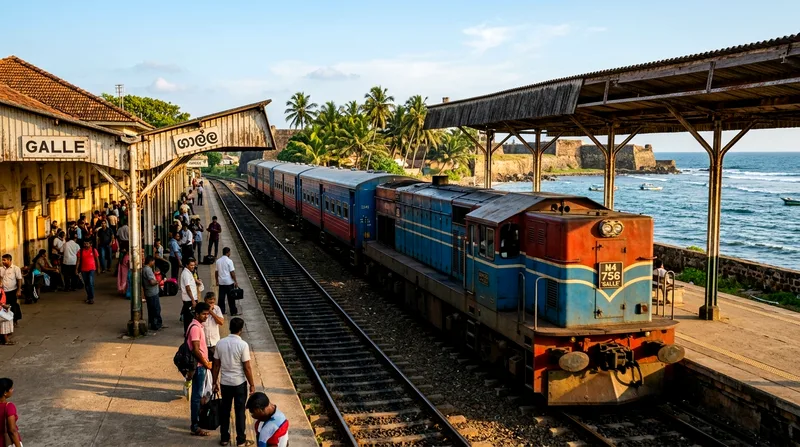
The Coastal Line starts at Colombo Fort station, the city's main rail hub, and runs south through Mount Lavinia, Kalutara, Bentota, Hikkaduwa and Galle before continuing on to Matara. Galle station sits right beside the old Dutch fort, a two-minute walk from the ramparts — genuinely convenient if you're heading into the UNESCO-listed old town. Trains that continue past Galle stop at Weligama and Mirissa, both popular surf and beach bases, before terminating at Matara. If your final destination is Mirissa rather than Galle, you don't need to change trains — just stay on board for another 25-30 minutes past Galle.
Journey time and how to check the timetable
Expect the Colombo Fort to Galle train to take roughly 2 to 2.5 hours, depending on the service and how many stops it makes. Intercity or "express" services run faster than the all-stations local trains, which can take closer to 3 hours. Sri Lanka Railways doesn't publish a single fixed frequency that holds year-round, so check trainschedule.lk or the official Sri Lanka Railways site before you travel rather than relying on a timetable you saw months ago. Several trains run the route daily, spaced through the morning and afternoon, but exact departure times shift periodically — don't plan a tight connection around an assumed schedule.
What Your Ticket Includes and Excludes
A basic Coastal Line ticket gets you from station A to station B — nothing more. It doesn't automatically include a seat, air conditioning, or luggage space, and it's worth being clear-eyed about that before you romanticize this ride too much. Third-class unreserved tickets are sold in bulk and oversold relative to seating, so if you board at an intermediate station like Bentota rather than at Colombo Fort, you may well stand for part of the journey.
What you're paying for, essentially, is passage and the view. There's no dining car, no reliable Wi-Fi, and toilets on board are basic — functional but not something you'll want to linger in. Some newer or upgraded carriages have reserved, air-conditioned seating, which does change the calculus considerably, especially in the middle of the day when the unreserved carriages get hot.
Seat reservations, luggage and onboard comfort
Reserved seats are bookable in advance through seatreservation.railway.gov.lk for certain intercity services, and this is the single best upgrade available on this route. A reserved ticket guarantees a seat, usually in a carriage with air conditioning, and removes the gamble of standing for two hours. Luggage space is limited — there are no overhead lockers or dedicated racks like on European trains, so a large suitcase becomes an obstacle you'll be guarding between your knees or wedging in a doorway. If you're traveling with surfboards, large backpacks, or anything bulky, the train becomes considerably less pleasant, and this is one case where I'd genuinely recommend a car or tuk-tuk transfer instead.
Ticket Classes and Train Types Compared
Sri Lanka Railways runs a mix of train types on the Coastal Line, and the class structure is simpler than, say, India's rail system but still worth understanding before you buy. Broadly, you're choosing between second class, third class, and — on select intercity services — a reserved, air-conditioned carriage sometimes marketed as an observation or saloon car. Fares across all classes are low by international standards, typically a few hundred Sri Lankan rupees for the Colombo–Galle leg, though exact pricing should always be confirmed at the station or on the official booking site since fares are adjusted periodically.
Reserved seats vs unreserved carriages
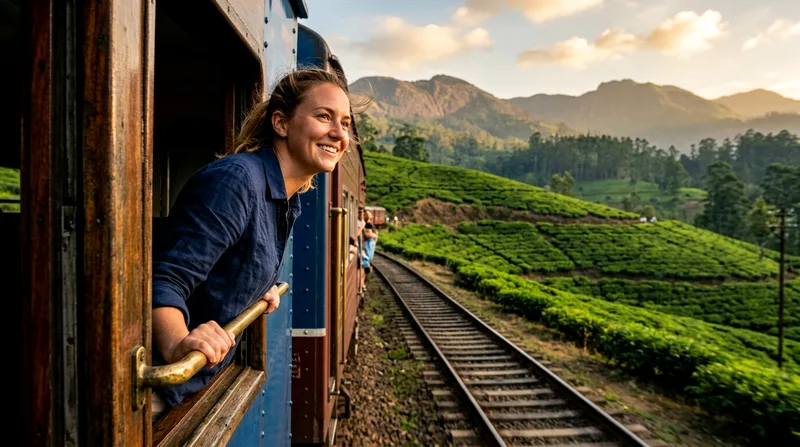
Unreserved third class is the classic backpacker experience: cheap, crowded, and the carriage doors are often left open, which is exactly how you get those photographs of someone leaning out toward the ocean. It's also uncomfortable if the train is full — and on weekends and holidays, it frequently is. Reserved seating, where available, costs more but is bookable ahead of time and takes the uncertainty out of the trip. If you're traveling with kids, elderly parents, or just don't want to stand for two hours, pay for the reserved option and book it as early as the system allows.
Best side to sit for ocean views
Heading south from Colombo Fort to Galle, the ocean is predominantly on the right-hand side of the train (facing the direction of travel). That's the side you want for the long open-water stretches around Kalutara, Bentota and Hikkaduwa. If you're coming back north from Galle to Colombo, the sea switches to the left-hand side. Seats aren't assigned by view on unreserved tickets, so arrive early and claim a window spot — on reserved services, there's no guaranteed way to pick a specific side when booking online, so it's worth asking at the counter if you're buying in person at Colombo Fort.
How to Book Official Train Tickets
Buying tickets for the Colombo to Galle train is straightforward if you stick to official channels and avoid anyone offering to "help" you at the station for a fee. The two legitimate routes are booking directly through Sri Lanka Railways' own reservation system or buying in person.
Booking online and at Colombo Fort station
For reserved seats on intercity services, use seatreservation.railway.gov.lk, the official Sri Lanka Railways booking portal. It requires some patience — the interface is dated and occasionally glitches during high-demand periods — but it's the legitimate source and avoids third-party markups. Third-party platforms like 12go.asia also sell Sri Lankan train tickets and can be easier to navigate for non-Sinhala or non-Tamil speakers, usually with a modest service fee added on top of the base fare. For unreserved third-class tickets, there's no need to book ahead at all: just buy at the counter at Colombo Fort station on the day, ideally 30-45 minutes before departure to secure a reasonable queue position and a shot at a seat.
When to book and extending to Mirissa
Reserved seats for popular departures can sell out, particularly around Sri Lankan public holidays, the Christmas-New Year period, and weekends in peak tourist season (roughly December through March). Booking a few days ahead is sensible if your dates are fixed; booking weeks ahead isn't usually necessary or even possible, since the reservation window on the official system tends to open closer to the travel date. If you're continuing to Mirissa or Matara, buy your ticket straight through to that station — there's no need to buy separately for the Galle-to-Mirissa leg, and trying to do so just adds a transaction for no benefit.
Train vs Expressway: Which Is Better?
This is the real decision most travelers are weighing, and the honest answer is: it depends what you value more, time or atmosphere. The Southern Expressway (E01) connects Colombo to Galle by road in roughly 1.5 to 2 hours by private car or airport taxi — noticeably faster and more predictable than the train, with none of the standing-room risk. Air-conditioned long-distance buses also use the expressway and are a cheap, fast alternative, though they skip the coastal scenery entirely since the highway runs inland.
Compare this to other parts of Asia: it's a bit like choosing between India's Konkan Railway and a flight from Mumbai to Goa, or Vietnam's Reunification Express versus a budget flight to Da Nang — the train is slower and less certain, but it's the only option that puts you directly beside the water for two hours straight.
The train offers the best scenery and lowest cost, while the expressway by car is the fastest and most reliable option.
Colombo to Galle train vs expressway vs bus compared
| Option | Typical duration | Cost level | Scenery | Luggage space | Best for |
|---|---|---|---|---|---|
| Coastal train (reserved) | 2-2.5 hrs | Low-Moderate | Excellent, ocean-side | Limited | Scenery seekers, couples |
| Coastal train (unreserved) | 2.5-3 hrs | Very low | Excellent, open doors | Very limited | Backpackers, solo travelers |
| Private car/taxi (E01 expressway) | 1.5-2 hrs | High | Minimal, inland highway | Good | Families, heavy luggage |
| Intercity bus (expressway) | 2-2.5 hrs | Low | Minimal, inland highway | Moderate | Budget travelers in a hurry |
Durations and fares are approximate and vary by service, traffic and season; confirm current schedules on trainschedule.lk or the official Sri Lanka Railways booking site before travel.
Train, bus and taxi pros and cons
The train wins on scenery and cost-per-kilometre, and it's unbeatable for photography — nothing on the expressway comes close to the view from an open carriage door near Hikkaduwa. It loses on reliability, comfort, and luggage space. A private taxi or Grab/PickMe car wins on speed, door-to-door convenience, and comfort, but costs considerably more and you'll see nothing but highway barriers for most of the trip. The bus sits in between: cheaper than a taxi, faster than the train, but cramped and scenery-free. For a traveler without heavy bags who has time to spare, the train is the better story. For a family with suitcases catching an afternoon check-in at a Mirissa hotel, I'd book a car.
Is the Coastal Train Worth It?
Yes, with conditions. The Colombo to Galle train earns its reputation — there's a real stretch past Kalutara and again near Ambalangoda where the track runs so close to the shoreline that waves occasionally spray the windows during rough weather. That's not something an expressway or a flight to Maldives or Bali can replicate; this is a specifically Sri Lankan experience tied to the geography of this one coastline. But it's not comfortable in the way a tourist train in, say, Switzerland or even Kerala's backwater boat trips might be. It's hot, it's crowded, and reliability is middling.
Best choice by traveller type
Solo travelers and couples with light packs: take the train, ideally with a reserved seat, and treat it as part of the experience rather than mere transport. Families with young children: consider the reserved intercity service if available, or default to a private car if a reservation isn't open for your dates — standing with a toddler for two hours isn't worth it. Surfers heading to Mirissa or Weligama with boards: a car or a boarded-friendly transfer van beats the train, which has nowhere to store a board safely. Senior travelers: the train is doable but expect no step-free boarding and uneven platform heights at some stations — a taxi is the lower-stress choice if mobility is a concern. Budget backpackers: the unreserved third class is genuinely one of the best-value scenic rides anywhere in Asia, cheaper than comparable trips in Thailand or Vietnam, provided you're flexible about standing.
Frequently asked questions
How long is the train from Colombo to Galle?
Journey time is typically 2 to 2.5 hours on faster intercity services, and closer to 3 hours on all-stations local trains. Delays happen, so build in buffer time if you have a connecting booking in Galle or beyond, and check trainschedule.lk for the specific service you plan to take.
How do I book a train ticket from Colombo to Galle online?
For reserved seats, use the official portal at seatreservation.railway.gov.lk, which covers select intercity services. Third-party sites like 12go.asia also sell tickets for a small service fee and are easier for non-local speakers to navigate. Unreserved third-class tickets aren't bookable online — buy those at the counter at Colombo Fort station on the day of travel.
How many trains run from Colombo to Galle each day?
Several trains run the Coastal Line route daily, spread across the morning and afternoon, but exact frequency and timing change periodically. Sri Lanka Railways doesn't guarantee a fixed year-round schedule, so check trainschedule.lk or the official railway site close to your travel date rather than relying on older published timetables.
Which side of the train has the best sea views?
Traveling south from Colombo Fort to Galle, sit on the right-hand side (facing forward) for the best ocean views along stretches like Kalutara and Hikkaduwa. Heading north back to Colombo, the sea is on the left-hand side instead. Unreserved seating is first-come, so board early at Colombo Fort to claim a window spot.
Is the train or the expressway better from Colombo to Galle?
The train is better for scenery, atmosphere and cost; the Southern Expressway is faster and more reliable, typically 1.5 to 2 hours by private car versus 2 to 2.5 hours or more by rail. Choose the train if you value the coastal view and have light luggage; choose a car or expressway bus if you're short on time or traveling with heavy bags.