Discover Sri Lanka kottu: the story and rhythmic sound of kottu roti, its best variations, and where to eat it in Colombo, from stalls to food tours.
What Is Sri Lankan Kottu Roti?
Sri Lanka kottu is shredded flatbread stir-fried on a flat griddle with egg, vegetables, and usually meat or seafood, bound together with a splash of curry sauce and a hit of chili. It's not a dish you'll find neatly listed on international "Asian food" menus alongside pad thai or biryani, which is part of why it surprises visitors — there's nothing quite like it outside Sri Lanka. Think of it loosely as a cousin to fried rice or a paratha stir-fry, but built on bread instead of grain, with a texture somewhere between chewy and crisp.
The dish is everywhere once you start looking: roadside stalls, bus station kiosks, beach-town cafés in Mirissa and Unawatuna, and upscale restaurant menus in Colombo that serve a "gourmet" version with cashew or truffle oil. That range tells you something — kottu isn't tied to one social class or setting. A construction worker and a hotel guest might order the same chicken kottu an hour apart from the same cart.
Origins and Evolution of the Dish
Kottu likely emerged as a practical solution to leftover godamba roti — the thin, flaky flatbread served with curries across Sri Lanka. Rather than waste bread gone slightly stale, cooks began chopping it up and frying it with whatever vegetables, egg, or meat were on hand. That improvised, use-it-up origin still shapes the dish: kottu is built for flexibility, not precision. Over decades it moved from home kitchens to roadside carts to city menus, picking up regional twists along the way — more seafood on the coast, more cheese in tourist-heavy areas, spicier versions inland. It's now arguably as recognisable a national dish as rice and curry, though it carries none of rice and curry's formality.
Core Ingredients and Components
The backbone is godamba roti, a thin, oiled flatbread similar in spirit to a paratha. Cooks shred it fresh on the griddle rather than pre-cutting it, which matters for texture — it stays slightly chewy rather than turning soggy. To that base, they add beaten egg, shredded cabbage, carrot, onion, and a protein: chicken, beef, mutton, cuttlefish, or just extra vegetables and egg for a vegetarian plate. A ladle of curry gravy — often from whatever meat curry is cooking that day — gets mixed through for moisture and flavour, along with soy sauce in many stalls, a modern addition that gives kottu its faint umami edge. Chili is added to taste, and in most places, "taste" means more than a visiting European traveller expects.
The Sound and Technique Behind Kottu
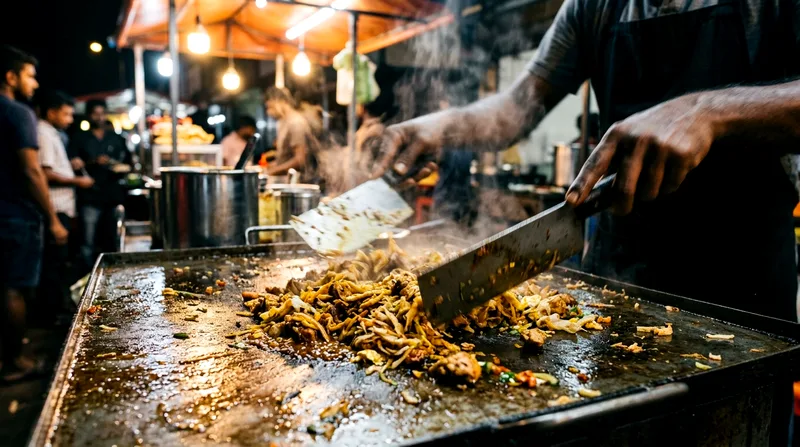
You'll hear kottu before you see it. That rhythmic metallic clatter — fast, syncopated, almost musical — is as much a part of the dish as the taste. Walk through any night market in Sri Lanka and the sound carries over traffic noise and chatter; it's practically an advertisement in itself.
Why Kottu Makes Its Rhythmic Clatter
The sound comes from two flat metal blades — sometimes they look like cleavers, sometimes more like dough scrapers — hitting a steel griddle in alternating strokes as the cook chops and tosses the roti into thin strips. Some cooks develop personal rhythms, almost performative, especially at stalls with a bit of showmanship aimed at passing customers. It's not just noise for noise's sake: the chopping motion has to be constant to keep the shredded bread moving, mixing evenly with egg and vegetables without sticking or burning. A skilled cook can keep two blades going in a near-continuous beat for the full few minutes it takes to cook a plate.
How Kottu Roti Is Made
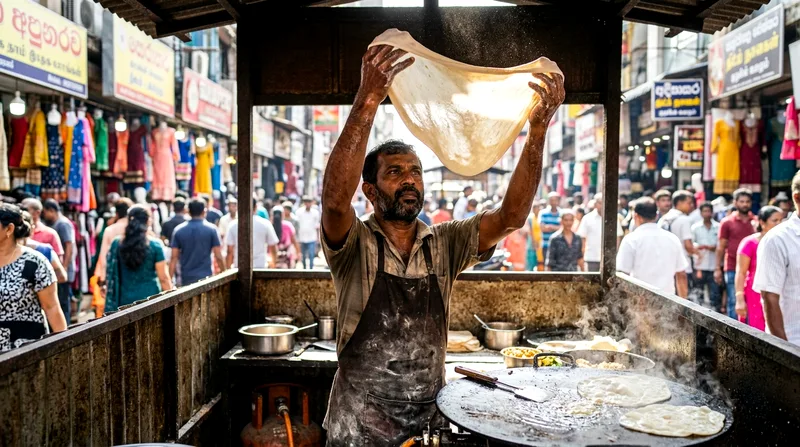
The process starts with a hot, well-oiled flat griddle, usually gas-fired and built into the stall. Pre-made godamba roti gets laid on, then chopped directly on the surface — this is unusual compared to most stir-fried dishes, where ingredients are prepped separately before hitting the pan. Egg is cracked on next and scrambled into the mix, followed by vegetables, protein, and the curry gravy. The whole thing gets tossed and chopped simultaneously for a few minutes until everything is well combined and slightly crisp at the edges. It's fast food in the truest sense: most orders are ready in under five minutes, cooked to order rather than kept warm in a tray.
Popular Types of Kottu
Kottu's variations are less about wildly different recipes and more about what gets added to the base formula. Once you understand the core technique, the "types" are easy to navigate on any menu, even one only in Sinhala.
Chicken kottu is the safest first order, while cheese and seafood versions suit travellers wanting something richer or coastal.
Types of Sri Lanka kottu compared: ingredients, spice level and where to find them
| Kottu Type | Main Ingredients | Typical Spice Level | Best Found In |
|---|---|---|---|
| Chicken Kottu | Roti, chicken, egg, cabbage, curry gravy | Medium | Nationwide, Colombo stalls |
| Egg (Mutta) Kottu | Roti, egg, onion, cabbage | Medium | Nationwide, vegetarian-friendly |
| Vegetable Kottu | Roti, cabbage, carrot, leeks | Mild to medium | Nationwide, temples areas |
| Cheese (Dolphin) Kottu | Roti, cheese, egg, chicken optional | Mild to medium | Beach towns, Unawatuna, Hikkaduwa |
| Seafood Kottu | Roti, cuttlefish or prawns, egg | Medium to hot | Coastal towns, Negombo |
| Northern/Eastern Style | Roti, chili, minimal gravy | Hot | Jaffna, Trincomalee |
Spice levels vary by stall and can usually be adjusted on request; figures are general patterns, not fixed rules.
Classic Chicken, Egg and Vegetable Kottu
Chicken kottu is the most ordered version nationwide, and it's a safe, reliable choice for first-timers — the chicken is usually diced small and well-cooked, not pink or rubbery if the stall has decent turnover. Egg kottu, sometimes called "mutta kottu," skips meat and leans on scrambled egg for richness; it's a good vegetarian-leaning option, though it's not vegan since most stalls use the same shared griddle and oil across dishes. Vegetable kottu, built from cabbage, carrot, leeks, and sometimes potato, is the lightest version and the one most likely to satisfy a strict vegetarian, though you should still ask about egg and fish-based sauces if that matters to you.
Cheese, Dolphin and Regional Variations
Cheese kottu — sometimes marketed as "dolphin kottu" at tourist-facing cafés, with no actual dolphin involved — adds a layer of melted cheese on top, a format that took off in beach towns like Unawatuna and Hikkaduwa where travellers wanted something richer and more familiar. Seafood kottu, built with cuttlefish or prawns, shows up more on the coast and in Negombo. In the north and east, you'll find spicier, drier versions with more chili and less gravy. None of these variations are "more authentic" than the others — kottu has always adapted to local ingredients and audience, and the cheese version, despite the gimmicky name, is now a legitimate regional staple rather than a tourist trick.
Where to Try Kottu in Colombo
Colombo is the easiest place to eat your way through kottu's range in a single trip, from no-frills carts to restaurant versions with better seating and air conditioning. The Pettah market area is a good starting point for street-level kottu — it's chaotic, cash-based, and exactly where you want to be hungry around 7 or 8pm when stalls hit their stride. Residential neighbourhoods like Bambalapitiya and Wellawatta also have long-running stalls that locals treat as regular dinner spots rather than novelties.
What to Look for in a Great Stall
Look for a queue, or at least a steady stream of locals — that's the single best indicator, better than any online review. A busy griddle means fresh roti and fast turnover, which matters because kottu sitting around loses its texture fast. Watch the chopping: a confident, steady rhythm usually signals an experienced cook who won't overcook the egg or burn the cabbage. Avoid stalls where the gravy looks like it's been sitting since lunch, and be cautious of places with no visible fridge or ice for drinks if hygiene is a concern — bottled water and canned drinks are the safer call over anything from an open container.
General Price Expectations
Street-level kottu in Colombo is genuinely cheap — a filling plate of chicken or egg kottu typically costs the equivalent of a budget lunch anywhere in Southeast Asia, comparable to a plate of pad kra pao in Thailand or a thali in Kerala, and noticeably less than a similar-sized meal in Bali's tourist zones or the Maldives' resort restaurants. Cheese or seafood versions cost more, and restaurant settings in Colombo 03 or Colombo 07 will charge several times the street price for the same basic dish, plus service and a nicer chair. Either way, kottu remains one of the better value meals in the country relative to how filling it is — portions are large and carb-heavy, meant to be dinner, not a snack.
Kottu Food Tours and Street Food Culture
Sri Lankan street food culture runs on timing — many of the best kottu stalls don't open until early evening and peak well after dark, which doesn't always suit families with young kids or travellers nervous about navigating unfamiliar streets at night. That's the honest trade-off: the best kottu experience happens exactly when solo wandering feels least comfortable to some visitors.
Why a Guided Tour Helps First-Timers
A kottu-focused or broader street food tour in Colombo solves the timing and navigation problem in one move. Guides typically walk small groups through several stalls in Pettah or nearby neighbourhoods over two to three hours, pairing kottu with other staples like hoppers, isso wade, or short eats. For families and senior travellers, this removes the guesswork around hygiene and spice level, and it's genuinely useful for solo travellers who'd otherwise skip the busiest, most interesting stalls out of caution. Compare this to food tours in Hanoi or Bangkok — the format is similar, but Colombo's scene is noticeably less tourist-saturated, so you're eating alongside commuters and shift workers, not other visitors.
Ordering Tips and Spice Levels
If you're not used to Sri Lankan chili heat, say so when ordering — "less spicy" or "mild" ("adu sambol" cues aside) is a completely normal request, and most cooks will adjust without judgment. Expect kottu to be served with a side of curry gravy or a thin sambol for extra dipping; pour it on gradually rather than all at once. Eating with a spoon is standard and expected, despite the dish's street-food setting — nobody expects chopsticks or hands here, unlike with some other Sri Lankan rice-and-curry meals. If you're travelling with children, egg or vegetable kottu ordered mild is usually the safest entry point before working up to chicken or cheese versions with more chili.
Frequently asked questions
What is a Sri Lankan kottu?
Kottu is a stir-fried street food made from shredded flatbread (godamba roti), egg, vegetables, and often meat or seafood, mixed with curry gravy and chili on a hot griddle. It's eaten as a full meal, usually for dinner, and is one of the most widely eaten dishes across Sri Lanka, from roadside stalls to restaurant menus.
How is kottu roti made?
Cooks chop pre-made roti directly on a hot griddle using two flat metal blades, then mix in egg, vegetables, protein, and curry gravy while continuing to chop and toss everything together. The whole process takes only a few minutes and produces the dish's signature rhythmic, clattering sound.
What are the main types of kottu in Sri Lanka?
Common types include chicken kottu, egg (mutta) kottu, vegetable kottu, cheese kottu (sometimes called dolphin kottu, with no actual dolphin), and seafood kottu made with cuttlefish or prawns. Regional versions in the north and east tend to be drier and spicier than the gravy-heavy versions common in Colombo.
Where can I find the best kottu in Colombo?
Pettah's market streets and residential areas like Bambalapitiya and Wellawatta have long-running stalls favoured by locals, generally a better bet than hotel restaurant versions. Look for a steady queue of locals and a confident, steady chopping rhythm — both are reliable signs of a fresh, well-run stall.
What makes the sound when cooking kottu?
The clatter comes from two flat metal blades striking the steel griddle in alternating strokes as the cook chops shredded roti and mixes in the other ingredients. The constant motion keeps everything from sticking or burning, and skilled cooks develop a steady, almost musical rhythm that carries down the street.