Explore Sri Lanka food from hoppers to lamprais. Learn the essential dishes, rice and curry basics, spice levels for families and where to taste them.
What Makes Sri Lankan Food Distinctive
Coconut turns up in nearly everything — grated into sambols, pressed into milk for curries, scraped and roasted for condiments. Curry leaves, pandan, cinnamon bark (Sri Lanka still grows some of the best in the world), and a roasted curry powder specific to the island give the food a smokier, darker flavor than many visitors expect. Chili arrives early and often. This isn't a cuisine that hides its heat behind subtlety.
Sri Lanka food sits at a crossroads shaped by Portuguese, Dutch and British colonization, Tamil and Muslim trading communities, and a fiercely local Sinhalese cooking tradition that predates all of them. You taste that history directly: lamprais from Dutch Burgher kitchens, lunu miris and dried fish traditions from coastal communities, and biryani-adjacent rice dishes from Muslim Sri Lankan cooks. Nothing about it is a watered-down version of a neighboring cuisine, even though it gets filed that way by people who've only had Indian food.
If you're landing in Colombo expecting one unified "Sri Lankan restaurant" experience, recalibrate. What you eat in Jaffna in the north — heavy on Tamil influence, tamarind and dried shrimp — bears only partial resemblance to what you'll find in Galle or Negombo on the south and west coasts, where seafood curries and coconut-based sauces dominate. The hill country around Kandy leans into root vegetables and heartier, less seafood-driven meals. One country, several distinct food regions.
Core spices, coconut and fresh seafood
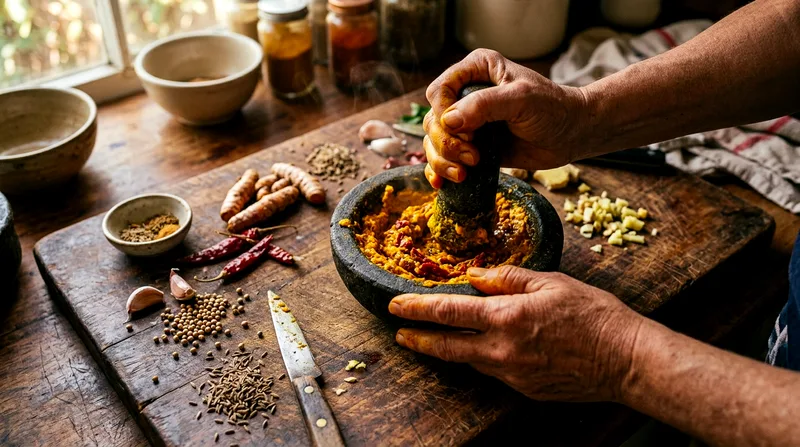
The spice backbone is roasted curry powder (a blend of coriander, cumin, fennel, and curry leaves toasted dark before grinding), plus fresh turmeric, pandan leaf, lemongrass, and Maldive fish — small sun-dried fish flakes used as a savory base even in vegetable dishes. Coconut shows up in three forms: fresh milk for curries, scraped coconut for sambols, and coconut oil for frying. Along the coast — Negombo, Galle, the entire southern belt — expect fresh tuna, seer fish, crab and prawns cooked in coconut-based curries within hours of being caught. Inland, in the hill country near Kandy, you'll see more lentils, jackfruit and green leafy mallung (a shredded vegetable and coconut dish) because fresh seafood isn't practical.
Is Sri Lankan food like Indian food?
There's overlap — both use curry leaves, coconut, rice as a staple, and similar spice families — but Sri Lankan food is generally drier in texture, more reliant on roasted (rather than raw) spice blends, and built around a wider range of sambols and pickles eaten alongside the main curries rather than as garnish. Compare it to Kerala, India, which is probably the closest regional cousin: Kerala's coconut-and-seafood cooking shares real DNA with Sri Lanka's coastal food, but Sri Lankan meals tend to pack more small side dishes onto one plate and use Maldive fish flakes in a way Kerala cooking doesn't. If you've eaten mostly North Indian food — rich gravies, naan, tandoori meats — Sri Lanka will feel like a different cuisine entirely.
Sri Lanka Rice and Curry Explained
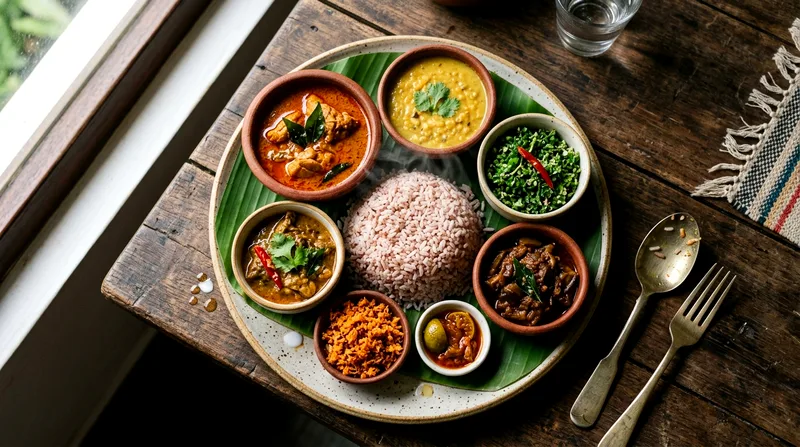
Rice and curry is the backbone meal of Sri Lanka food, and it's not one dish — it's a format. Order it at a basic local restaurant (sometimes called a "hotel," confusingly, though it just means an eatery) and you'll get a pile of rice with four to eight small curries arranged around it: maybe a chicken or fish curry, a dhal (lentil curry), a beetroot curry, some long beans or okra, a coconut sambol, and a crunchy papadam on the side. Each curry is cooked separately with its own spice balance, which is what makes the format interesting — you're not eating one flavor, you're building a plate from eight different ones.
I'd argue rice and curry is best eaten at lunch, which is when it's freshest and most restaurants prepare their full spread for the day. By dinner, some curries have been sitting for hours. If you're choosing between a lunch buffet and an evening à la carte order, take the lunch buffet — you'll taste more dishes and get better quality for roughly the same cost.
Spice intensity and signature dishes shift noticeably as you move from Colombo to Jaffna, so match your region to your heat tolerance.
Sri Lanka food by region: what to expect and where it's hottest
| Region | Signature Dish | Typical Spice Level | Best For |
|---|---|---|---|
| Colombo | Lamprais, short eats | Medium | Widest variety, first-time visitors |
| Negombo | Seafood curry | Medium | Fresh fish and prawns |
| Galle | Fish ambul thiyal | Medium-High | Sour, tangy coastal curries |
| Kandy / Hill Country | Vegetable curry, mallung | Mild-Medium | Families, vegetarians |
| Jaffna | Crab curry, mutton curry | High | Spice-tolerant travelers |
Spice levels are general tendencies, not fixed rules — individual cooks and restaurants vary widely, so always ask before ordering.
What is on the plate
A typical spread includes a protein curry (chicken, fish or occasionally beef — pork is less common given the island's Muslim and Buddhist populations), a dhal curry almost always present, a green vegetable mallung, a sambol (pol sambol is the classic grated coconut, chili and lime mix), pickled vegetables (achcharu), and crisp papadams. Rice is usually a red or white local variety, sometimes replaced with string hoppers or kottu on request. The volume can be overwhelming for first-timers — don't feel obliged to finish every bowl.
Vegetarian and vegan options
This is genuinely one of the easier Asian cuisines for vegetarians and vegans, arguably easier than Vietnam or much of Thailand where fish sauce hides in everything. Dhal curry, jackfruit curry (polos), pumpkin curry, beetroot curry, and mallung are all naturally vegan in most households. The catch is Maldive fish flakes, which turn up in sambols and some vegetable curries as a savory base — ask specifically if you want strict vegan food, since "vegetarian" in casual conversation doesn't always exclude it.
Breakfast Dishes: Hoppers, String Hoppers and More
Sri Lankan breakfast is, in my opinion, underrated compared to the country's lunch and dinner spreads — it deserves equal billing. The two anchor dishes are hoppers (appa) and string hoppers (idiyappam), and most travelers end up eating one or both daily without getting bored, which says something.
Hoppers and string hoppers
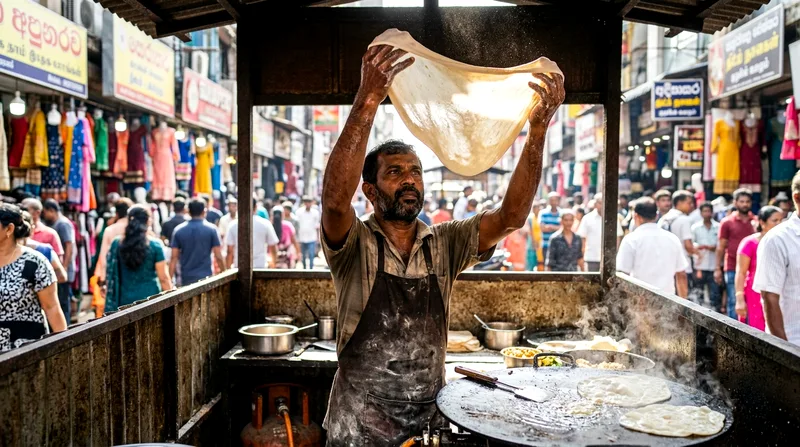
A hopper is a bowl-shaped pancake made from fermented rice flour and coconut milk, cooked in a small curved pan so the edges turn crisp and lacy while the center stays soft. Egg hoppers crack a whole egg into the center as it cooks. String hoppers are steamed rice flour noodles pressed into flat discs — mild, slightly chewy, and meant to be eaten with curry rather than on their own. Both are breakfast staples from Negombo to Kandy, though you'll also find hoppers sold as a dinner street food in cities like Colombo, cooked to order on griddles set up along the roadside after dark.
Pol sambol, kiribath and roti
Pol sambol — grated coconut mixed with chili powder, lime juice, onion and sometimes Maldive fish — belongs on nearly every breakfast table and most lunch ones too. Kiribath is coconut milk rice pressed into diamond-shaped blocks, traditionally eaten on auspicious occasions and New Year's morning but widely available as an everyday breakfast, usually with lunu miris (a fierce onion-chili paste) or jaggery. Roti here means pol roti, a dense coconut flatbread, distinct from the thinner Indian version — pair it with a dhal curry and you have a complete, filling breakfast for well under what a hotel buffet costs.
Essential Sri Lankan Dishes and Street Food
Beyond the daily rice and curry rhythm, a handful of dishes are worth planning a meal around specifically. Sri Lanka food culture treats these less as everyday eating and more as things you seek out.
Lamprais, kottu and fish ambul thiyal
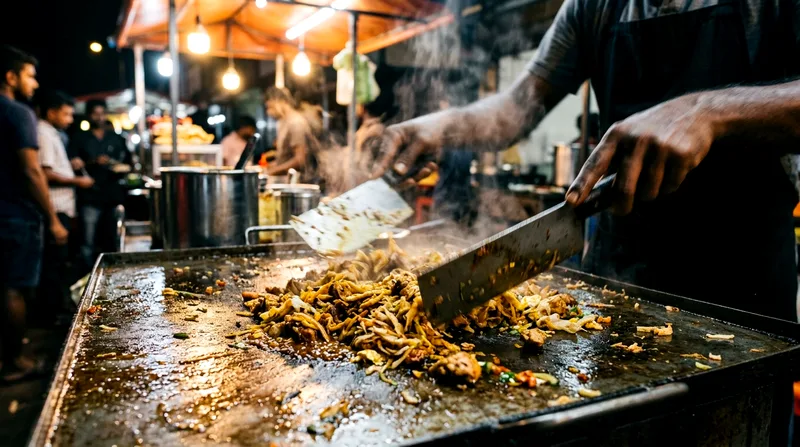
Lamprais is the clearest expression of Dutch Burgher cuisine on the island — rice cooked in meat stock, served with a meat or mixed curry, a meatball (frikkadel), blachan (a shrimp paste), and seeni sambol, all wrapped in a banana leaf and baked. It's rich, labor-intensive, and worth seeking out specifically rather than expecting at a casual lunch spot. Kottu roti is the opposite experience: chopped roti bread stir-fried on a flat griddle with egg, vegetables, and meat or cheese, made loudly and visibly, the rhythmic chopping sound a signature of Sri Lankan night markets from Colombo to Galle. Fish ambul thiyal is a sour, dry fish curry from the south coast made with goraka (a tamarind-like fruit) — no coconut milk, intensely tangy, and one of the dishes that best shows Sri Lanka food isn't always coconut-forward. Jaffna, in the north, has its own signature in crab curry and mutton dishes built on a sharper, Tamil-influenced spice profile that's noticeably hotter than what you'll find further south.
Street food safety tips
Street food in Sri Lanka is generally safe if you follow the basic rule that applies anywhere: eat where there's a queue of locals and high turnover, because that means the food isn't sitting around. Kottu stalls, hopper vendors, and short-eats shops (selling savory pastries like fish buns and cutlets) are usually cooked to order over high heat. Avoid anything pre-cut and sitting out, like fruit stalls without refrigeration in direct sun — a real risk in Colombo's heat. Bottled or boiled water only, and go easy on roadside juice stalls unless you watch them blend it fresh in front of you.
Spice Levels for Families
Is Sri Lankan food spicy? Yes, more consistently than most Thai or Vietnamese food, and often hotter than what you'd get in a UK or Australian "Sri Lankan restaurant," which tend to mellow things down. Chili isn't an optional garnish here — it's built into the base of most curries. That said, families traveling with children manage fine once they know which dishes to lean on and how to order.
Mild dishes kids usually enjoy
Dhal curry is usually the gentlest curry on the table and a safe default for children. Kiribath (coconut milk rice) has no heat at all. Plain string hoppers or hoppers without sambol are completely mild — just add a little curry on the side for kids to dip rather than pour over. Kottu can be made without chili on request, and devilled dishes aside, plain fried rice or noodles are widely available even at local spots, since many Sri Lankan menus cater to both tourists and families already.
How to ask for less heat
"Not spicy" or "less spicy please" works in most tourist-facing restaurants and is understood even at local eateries in Negombo, Kandy or Galle. Asking for curries "without chili" is more reliable than asking for "mild," which gets interpreted loosely. If you're unsure, order one curry at a time rather than the full rice and curry spread, taste it, then add more. Hotels catering to European travelers and families are generally used to the request and will tone things down without much fuss — it's small local lunch spots in Jaffna and the south where the baseline heat runs highest and adjustments are less predictable.
Where to Taste Sri Lankan Food
Food is one of the better reasons to structure a Sri Lanka itinerary around regions rather than just beaches and temples. Pairing meals to place gives you a genuinely different experience city to city, in a way that, say, Bali's fairly uniform warung food doesn't.
Regional specialties by area
Colombo offers the widest range — everything from street-level short eats to Dutch Burgher lamprais and high-end reinterpretations of rice and curry. Negombo and the west coast specialize in fresh seafood curries, given the fishing harbor right there. Galle and the south deliver sour fish curries like ambul thiyal and strong coconut-sambol traditions. Kandy and the hill country lean toward vegetable-heavy, less fiery meals, plus good tea-estate cafés if you need a break from curry. Jaffna, in the north, is the most distinct region food-wise — Tamil-influenced, heavier on dried shrimp, tamarind, and genuinely hotter chili levels than the south. If you only have time for two food regions, Colombo plus Jaffna or Galle will show you the widest spread of what Sri Lanka food actually covers.
Food tours and cooking classes
Sri lanka food tours are worth booking rather than winging it, particularly in Colombo and Galle, where guided street food walks take you to stalls you'd likely walk past otherwise — unmarked kottu carts, short-eats shops with no English signage, juice stalls locals actually trust. A half-day food tour typically runs three to four hours and covers five to eight tasting stops. Cooking classes, common in Kandy and the hill country, usually include a market visit followed by hands-on preparation of a full rice and curry spread, running around half a day including the meal itself. Both are worth building into a broader itinerary alongside temple visits or a tea plantation tour — check current prices and availability when booking, since they vary by group size and season.
Frequently asked questions
What is Sri Lanka's famous food?
Rice and curry is the most iconic Sri Lanka food format, alongside hoppers (bowl-shaped coconut pancakes), kottu roti (stir-fried chopped flatbread), and lamprais, the banana-leaf-wrapped rice dish from Dutch Burgher cuisine. Pol sambol, the grated coconut and chili relish, appears on nearly every table and is arguably the single most representative taste of the island.
What is the main meal in Sri Lanka?
Lunch is traditionally the main meal, built around the full rice and curry spread with multiple small curries, a sambol, and papadam. Many households and local eateries prepare their largest spread at midday, with dinner often being a lighter version of the same format or simpler dishes like kottu or hoppers.
Is Sri Lankan food like Indian food?
There's overlap in spices and coconut use, but Sri Lankan food is generally drier, uses more roasted curry powders, and includes a wider variety of sambols eaten alongside curries. It's closest to Kerala's coastal cooking but still distinct — expect Maldive fish flakes and a different sambol culture that Indian regional cuisines don't typically share.
What do Sri Lankans eat for breakfast?
Common Sri Lankan breakfast dishes include hoppers and string hoppers served with curry and pol sambol, kiribath (coconut milk rice) with lunu miris, and pol roti with dhal. These are widely available at both roadside stalls and hotels across Colombo, Kandy and the coast.
How spicy is Sri Lankan food?
It runs hot by most standards, generally spicier than the Thai or Vietnamese food many travelers compare it to, with Jaffna in the north tending to be the hottest region. Most restaurants will reduce chili on request — ask for curries "without chili" rather than just "mild" for a more reliable result.